

With a total value exceeding US$2.9 trillion, more than 190 crop types, and over US$230 billion in aggregate crop production value, the U.S. farmland market represents a significant – and growing – market for investment.
Archives: Literature
Finding Success in the London-Listed Fund Market
U.S.-based managers are increasingly turning to London Stock Exchange, the most venerable market in the world for publicly traded closed-end investment companies, known in the U.K. as investment trusts.
Auction Funds

In recent years, interval and tender offer funds have improved access to alternatives. Now auction funds provide enhanced liquidity for illiquid private market assets.
The Interval Fund Renaissance: Why Should Investors Care?
Kimberly Flynn, CFA | Managing Director of Alternative InvestmentsWhen people think of traditional investment vehicles, they often think of mutual funds, ETFs, or private funds. But in recent years, a type of non-listed closed-end fund, known as the ‘interval fund’, has enjoyed a renaissance.
Using Alternatives to Achieve Your Retirement Goals

David Adler | Senior Advisor to XA Investments on EconomicsModern advancements in closed-end fund (CEF) design allow individuals access to a broader set of alternative investment options for retirement portfolios.
Overcoming the Liquidity Mismatch in Individual Investor Portfolios
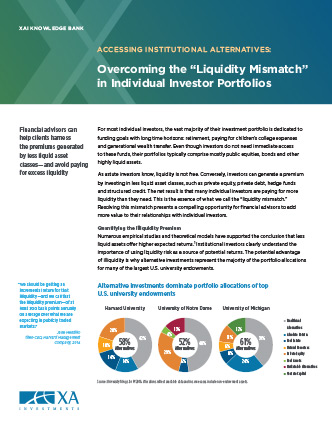
David Adler | Senior Advisor to XA Investments on EconomicsThis thought piece explores how financial advisors can help clients harness the liquidity premiums generated by less liquid asset classes – and avoid paying for excess liquidity.
Closed-End Funds: Providing Newfound Access to Institutional Alternatives
Closed-end funds (CEFs) have evolved considerably over the past two decades. Historically, CEFs have contained more traditional asset classes but repurposing them for the sake of offering unique entry to alternatives presents an opportunity for the investor.
Invest Like the Pros: Using Liquidity Premiums to Drive Better Portfolio Outcomes
David Adler | Senior Advisor to XA Investments on Economics This paper explores how investors can use liquidity premiums to drive better portfolio outcomes. It provides actionable ideas regarding the use of illiquid alternatives to help generate higher returns.
cont
